K-MAX
Kaman · United States · also known as Unmanned K-MAX, K-MAX Titan, CQ-24A · Updated
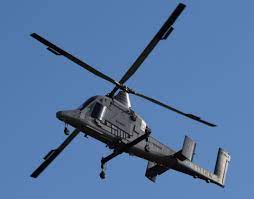
The unmanned K-MAX is an autonomous or remote-controlled cargo helicopter converted from Kaman's manned K-MAX power-lift synchropter, flown by the US Marine Corps on resupply missions in Afghanistan between 2011 and 2014. Kaman designed the airframe and Lockheed Martin, its partner since 2007 under "Team K-MAX," built the mission-management and flight-control systems that let it fly autonomously or by remote control without a pilot aboard.
Overview
Kaman began exploring an unmanned version of its K-MAX helicopter in 1998, and in March 2007 it signed a Strategic Relationship Agreement with Lockheed Martin to jointly pursue US Department of Defense opportunities for an unmanned cargo helicopter. Lockheed Martin and Kaman first demonstrated autonomous cargo resupply to the US Marine Corps in February 2010, and in December 2010 the US Naval Air Systems Command awarded Kaman a $46 million contract for two aircraft, followed by a five-day Quick Reaction Assessment in 2011. A formal evaluation by the US Navy's Commander, Operational Test and Evaluation Force found the unmanned K-MAX exceeded the Navy and Marine Corps' requirement to deliver 6,000 lb of cargo per day, and on 5 October 2011 the Marine Corps announced it would deploy the system to Afghanistan — the US Navy's first-ever operational deployment of a cargo unmanned aircraft system.
In December 2011, the Marines carried out the first unmanned cargo delivery in a combat zone, moving about 3,500 lb of supplies to Combat Outpost Payne. By February 2013 the aircraft had flown 600 unmanned missions and delivered about 2 million lb of cargo. On 5 June 2013 one unmanned K-MAX crashed during a resupply mission; investigators attributed the loss to unexpected tailwinds combined with a swinging external load, rather than pilot error or a mechanical fault. Both Marine Corps aircraft returned to the United States in May 2014 after nearly three years in theatre, having lifted a combined total of about 2,250 tons of cargo; they were later designated CQ-24A and moved to Arizona to support further US cargo-UAV development. The Marine Corps subsequently chose an unmanned MH-6 Little Bird variant over the K-MAX for a larger follow-on cargo-UAS competition. Separately, in April 2021 Kaman flew the K-MAX Titan, an optionally piloted commercial variant unrelated to the Marine Corps programme.
Design and capabilities
The unmanned K-MAX shares its airframe with Kaman's manned K-MAX: a synchropter with two intermeshing, counter-rotating main rotors, each 14.73 m in diameter, powered by a single Honeywell T53-17A-1 turboshaft flat-rated at 1,350 shp. The manned aircraft's fuselage is 12.73 m long, has a maximum take-off weight of 5,443 kg with a jettisonable slung load, and can lift up to 2,722 kg (6,000 lb) externally at sea level, falling to about 1,956 kg (4,313 lb) at 15,000 ft. Wikipedia gives a never-exceed speed of 185 km/h (100 kn) unloaded, a service ceiling of 4,572 m (15,000 ft), and a maximum range of about 556 km (300 nmi) with a full load; dividing its 228.5 US gal fuel capacity by its 85 gal/h consumption rate implies roughly 2.7 hours of endurance. Lockheed Martin's mission-management system allowed the aircraft to fly pre-planned routes autonomously or be flown by remote control from a ground station, without a pilot aboard.
Operational history
The unmanned K-MAX's only confirmed operational use was the US Marine Corps' Afghanistan cargo-resupply deployment from November 2011 to May 2014, which both companies and the Marine Corps have described as the first sustained use of an unmanned cargo helicopter in a combat zone. After its return and its loss of a follow-on Marine Corps competition to an unmanned MH-6 Little Bird variant, the airframes were redesignated CQ-24A and relocated to Arizona to support further US military cargo-UAV development rather than returning to frontline service.
Frequently asked questions
What is the unmanned K-MAX?
An autonomous or remote-controlled cargo helicopter converted from Kaman's manned K-MAX synchropter, developed with Lockheed Martin for the US Marine Corps.
Who operated the unmanned K-MAX?
The US Marine Corps, which flew it on cargo-resupply missions in Afghanistan from November 2011 to May 2014.
How much cargo could the unmanned K-MAX carry?
Up to about 2,722 kg (6,000 lb) externally at sea level, according to Wikipedia's figures for the K-MAX airframe.
Is the unmanned K-MAX still in service?
No. Both Marine Corps aircraft returned from Afghanistan in 2014, lost a later cargo-UAS competition to an unmanned MH-6 Little Bird variant, and were redesignated CQ-24A for further development work rather than operational use.
Who built the unmanned K-MAX?
Kaman designed and built the K-MAX airframe; Lockheed Martin, its partner since 2007, developed the autonomous flight and mission-management systems.