Black Hornet
Prox Dynamics · Norway · also known as PD-100 Black Hornet, Black Hornet Nano, PD-100 · Updated
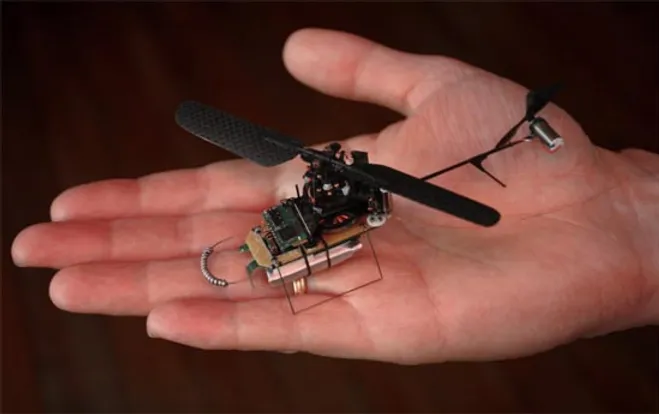
The Black Hornet, officially the PD-100, is a palm-sized reconnaissance helicopter drone developed by the Norwegian company Prox Dynamics, first sold to the British Army in 2012 as part of a "Personal Reconnaissance System" (PRS) small enough for a single soldier to carry, launch and operate. It was the first in what is now the Black Hornet family, later continued by Prox Dynamics' owner FLIR Systems (now Teledyne FLIR) as the Black Hornet 3 and Black Hornet 4.
Overview
Prox Dynamics, based in Hvalstad, Norway, developed the PD-100 as a nano-helicopter small enough to fit in a pocket, intended to give an individual dismounted soldier immediate, covert situational awareness without needing a dedicated UAV team. The company's breakthrough came in 2012, when the British Army bought the system for use by its Brigade Reconnaissance Force. According to AIN Online, Prox Dynamics had produced about 4,000 Black Hornet airframes and sold the system to around 15 nations by the time FLIR Systems acquired the company for approximately US$134 million in November 2016, after which Prox Dynamics became FLIR's unmanned aerial systems line of business; FLIR itself later became Teledyne FLIR following Teledyne Technologies' 2021 acquisition of FLIR.
In 2015, Prox Dynamics introduced a night-capable version of the PD-100 fitted with an infrared sensor. The US Marine Corps acquired PD-100 systems for test and evaluation, and the system was demonstrated at the US Army's Expeditionary Warrior Experiment at Fort Benning, Georgia; Prox Dynamics also marketed the PD-100 for law-enforcement and search-and-rescue use.
Design and capabilities
The PD-100 is a coaxial-rotor micro-helicopter roughly 10 cm long with a 12 cm rotor span. Army Technology gives its weight, including camera, as 16 g, while AIN Online gives the figure as 18 g; either way it is light enough to be one of the smallest fielded military UAVs. A steerable electro-optical camera in the nose streams live video and still images to a handheld controller over a proprietary two-way digital datalink, letting an operator see around corners, over walls or into buildings without exposing themselves; camera zoom is controlled from the base station. Sources differ slightly on its range and endurance: Army Technology states a controllable range of about 1,000 m and up to 25 minutes of flight time, while AIN Online gives an "advertised range" of 1.6 km (1 mile) with the same 25-minute endurance. The complete PRS kit — two Black Hornet airframes, a pocket-sized base station, a display and a hand controller — weighs under 1.3 kg in total.
Operational history
The UK Ministry of Defence awarded Prox Dynamics a $31 million contract via Marlborough Communications in 2012 for 160 PD-100 systems, with around 100 units delivered by early 2013; the British Army's Brigade Reconnaissance Force first deployed the PD-100 in Afghanistan. By the time of the FLIR acquisition in 2016, Prox Dynamics said about 15 nations used the system. Production has since moved on to the newer Black Hornet 3 and Black Hornet 4, which Teledyne FLIR now markets as the current members of the family.
Variants
- PD-100 / Black Hornet – the original Prox Dynamics design described here.
- Black Hornet 3 – later Teledyne FLIR production generation with improved endurance and sensors.
- Black Hornet 4 – current generation, adding thermal imaging and obstacle avoidance.
Frequently asked questions
Who makes the Black Hornet?
Prox Dynamics, a Norwegian company based in Hvalstad, originally developed the Black Hornet (PD-100); FLIR Systems, now Teledyne FLIR, acquired the company in 2016 and continues the product line.
How much does the Black Hornet weigh?
About 16–18 g for the aircraft itself, according to Army Technology and AIN Online; the complete carrying system weighs under 1.3 kg.
What is the range and flight time of the Black Hornet?
Sources give a controllable range of roughly 1,000 m to 1.6 km, with about 25 minutes of flight time per battery.
When did the Black Hornet enter service?
In 2012, when the British Army bought it for its Brigade Reconnaissance Force; Prox Dynamics said about 15 nations used the system by 2016.
How is the Black Hornet different from the Black Hornet 3 and 4?
It is the original Prox Dynamics design; the later Black Hornet 3 and Black Hornet 4, built by Teledyne FLIR, add longer endurance, improved sensors and, in the case of the Black Hornet 4, thermal imaging and obstacle avoidance.